
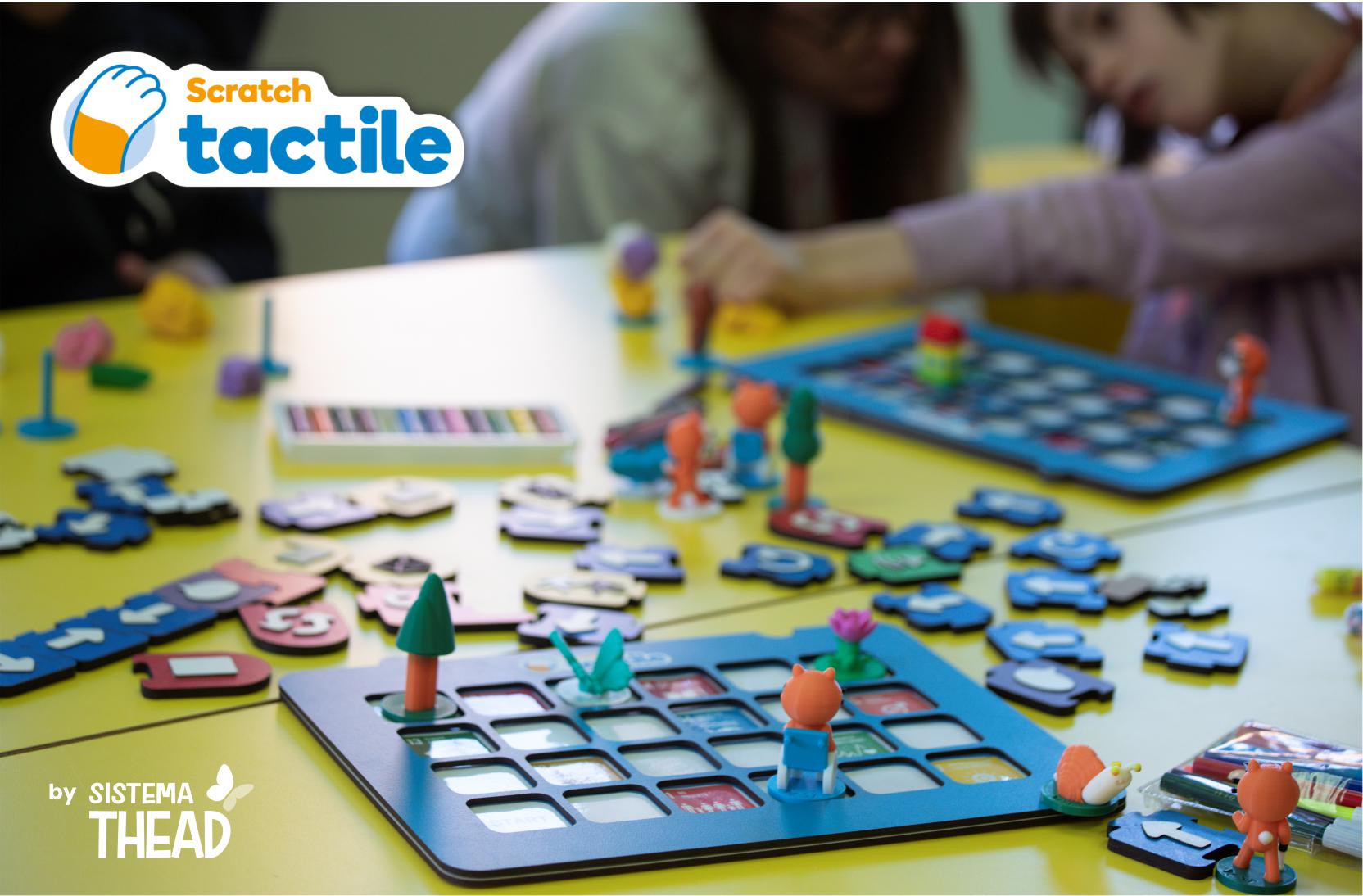
They have just received one of the European Digital Skills Awards 2026, a European recognition that highlights their work promoting more accessible and inclusive digital education. We wanted to know first-hand what this award means for Sistema THEAD, how Scratch Tactile was born and what the next challenges are for a project that is already present in more than 70 countries.
You have just become winners of the European Digital Skills Awards 2026. What does this recognition mean for Sistema THEAD and for the entire team behind the project?
THEAD System: Receiving this recognition reaffirms something that we have been defending for years: that digital education has to be inclusive from the beginning.
For us, the most important thing about this award is that it puts at the center a very clear idea: it is not acceptable that there are boys and girls who are left out of digital skills due to lack of access. When that happens, we are not talking about capacity, we are talking about barriers.
We also experience it as a recognition of the entire path we have traveled: the work with teachers, schools, families and students, and the conviction that we can innovate in another way, with more inclusion, more accessibility and more pedagogical sense.
It gives us energy to continue moving forward and expand the scope of the project so that it goes further and further.
Scratch Tactile has been recognized for driving more inclusive digital education. How did the idea come about and what need did you detect?
THEAD System: Scratch Tactile was born from a very specific experience. During an electronics activity, Maria, our co-founder, couldn't follow the instructions correctly because the components and texts were too small.
That made us wonder how many boys and girls could be facing the same difficulty and prompted us to develop a solution that would make programming and computational thinking accessible in a way that is truly accessible to everyone.
What impact is Scratch Tactile having on educational centers, teachers and students?
THEAD System: Scratch Tactile has already reached more than 70 countries and very different educational contexts. From the beginning we understood that each educational, social and cultural reality requires flexible and adaptable solutions.
One of the great values of the project is that it allows boys and girls with and without disabilities to participate together in programming and computational thinking activities.
In addition, we work very closely with the teachers, listening to their needs and accompanying them so that each center can adapt the proposal to its language, its curriculum and its context. We believe that inclusion is not only about designing an accessible tool, but about creating an initiative capable of responding to very diverse realities without losing its essence.
From your experience, what challenges still exist for digital education to be truly accessible and inclusive for all people?
THEAD System: One of the main challenges continues to be guaranteeing both access to technology and a truly inclusive digital pedagogy.
It is not enough to teach digital skills if the tools, content and methodologies are not accessible from the beginning. When a boy or girl cannot participate, the problem is not in their ability, but in the barriers of the system, which limit their right to learn, participate and develop their full potential.
After this European recognition, what are the next steps for Sistema THEAD?
THEAD System: This recognition encourages us to continue consolidating the projects we already have underway. In the coming months we want to improve Tactile Jr, advance the accessible Scratch Tactile application, develop Tactile Family and consolidate Diversi.
Our goal is ambitious: to impact one million boys and girls in 2030, growing step by step and always keeping accessibility at the center of everything we do.
The recognition received by Sistema THEAD shows that educational innovation generates a greater impact when it is developed from inclusion and accessibility. From the EduTech Cluster we want to congratulate the entire team for this achievement and wish them much success in the upcoming challenges. We will closely follow the evolution of a project that demonstrates that educational technology can be a real tool to guarantee quality education for all people.
_20240710102951.png)


_20240710104101.png)
_20240710104038.png)