
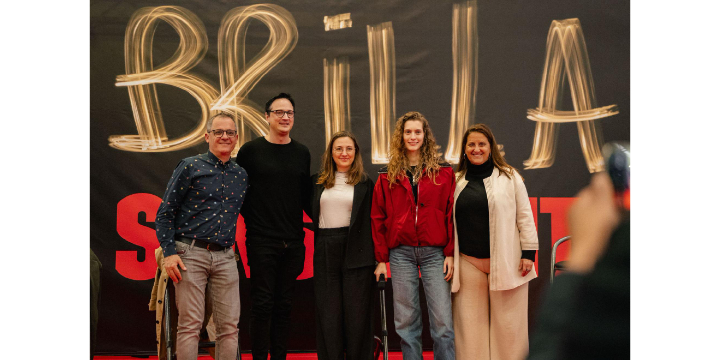
Barcelona, March 20, 2026 – Young people’s access to the labor market is undergoing a significant transformation, driving a more practical, flexible, and employment-oriented education model, especially in emerging creative professions. This was one of the main conclusions of the roundtable held this week at the Saló de l’Ensenyament in Barcelona, where experts from the education and technology sectors discussed new student priorities and the current state of the education system.
Future professionals are looking to “learn by doing” and enter the labor market as quickly as possible. “We are seeing less and less interest in accumulating theory without real application. People want to understand whether this can be their profession and start building a career path as soon as possible,” explained Berta Madueño, co-CEO and co-founder of TATTOOX.
In this context, Madueño highlighted the transformation of traditionally informal sectors such as tattooing, which have evolved towards structured training models: “Tattooing has always been learned from within the studio, through observation and time. What we are doing now is structuring that process, making it more accessible and better supporting those who want to pursue it professionally.”
The discussion focused on the evolution of education models towards hybrid formats that combine online learning with real practice. “The foundation of learning is built online, with guidance and a progressive structure. Moving to real practice is not the beginning, but the moment when everything learned gains real meaning,” Madueño added.
This view was shared by Marc Marzenit, CEO of Aulart, who emphasized that “the future must be hybrid” and highlighted how these models help democratize access to education.
The debate also addressed the professionalization of creative fields, as well as the growing role of technology and artificial intelligence in education.
From the EdTech ecosystem, Alicia Berlanga, Cluster Manager of the Edutech Cluster, highlighted the ability of these models to quickly adapt to labor market demands, noting that “AI is neither good nor bad—it is simply a reality, although the human component will remain essential.”
Magí Almirall, CEO of ILIKE Education, also emphasized the role of technology in the classroom and its ability to improve communication with students.
Finally, speakers agreed that EdTech plays a key role in enhancing employability, as it combines practical, flexible training aligned with real-world needs.
The session concluded that education is evolving towards more practice-oriented models focused on generating real opportunities. “We believe in a world where people can make a living from art and where artists are recognized as true professionals,” Madueño concluded.
_20240710102951.png)


_20240710104101.png)
_20240710104038.png)